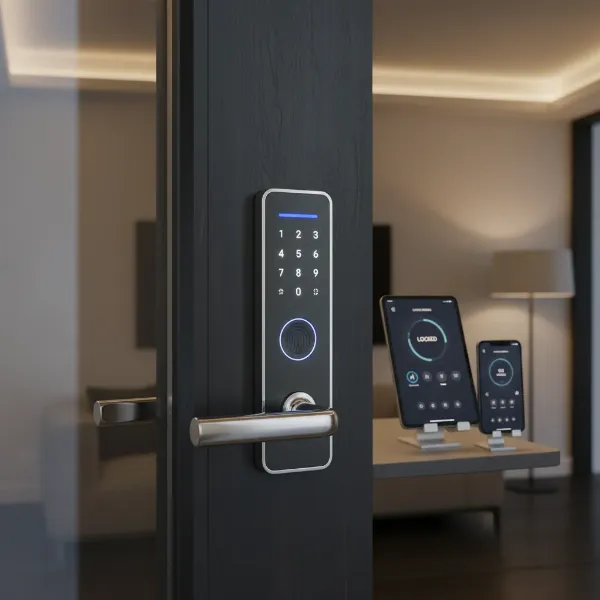
In today’s interconnected world, home security has evolved beyond simple locks and keys. Smart door locks promise unprecedented convenience and control, while traditional deadbolts continue to stand as bastions of time-tested physical security. Deciding between these two fundamental security solutions for your home involves weighing their distinct advantages and understanding their potential limitations. This comprehensive guide will navigate the intricacies of smart door locks and deadbolts, providing clarity to help you make the best choice for your peace of mind and property.
Understanding Smart Door Locks and Traditional Deadbolts
At their core, both smart door locks and traditional deadbolts serve the essential function of securing your entryway by extending a solid metal bolt into the door frame. The fundamental difference lies in how this bolt is controlled and the additional functionalities each offers.
A traditional deadbolt is a mechanical lock operated solely by a physical key. Its strength comes from its robust physical construction, featuring a solid steel bolt that resists forced entry, kicking, and jimmying. These locks have been a standard for residential security for centuries, valued for their mechanical reliability and straightforward operation. They require no power source and function independently of any external systems, making them dependable in all circumstances.
In contrast, a smart door lock integrates electronic components and wireless technology into the deadbolt mechanism. Instead of a traditional key, smart locks allow you to lock and unlock your door using a variety of digital credentials, such as a PIN code on a keypad, a fingerprint scan, a smartphone application, or even voice commands. Many smart locks connect to your home’s Wi-Fi, Bluetooth, Z-Wave, or Zigbee network, enabling remote access, monitoring, and integration with broader smart home ecosystems. While a smart lock still employs a physical bolt, its operation is digitally managed, bringing a new layer of convenience and control.
The Advantages of Smart Door Locks
Smart door locks bring a suite of features designed to enhance convenience, control, and connectivity in modern homes. They represent a significant upgrade for those seeking a more integrated and flexible security solution.
One of the most compelling advantages is keyless entry. Imagine arriving home with arms full of groceries and simply tapping a code, scanning your finger, or having your door automatically unlock as you approach, eliminating the need to fumble for keys. This keyless access can be managed through personalized PINs for family members, temporary codes for guests or service providers, or even biometric recognition like fingerprints. These digital “keys” can be easily granted or revoked from your smartphone, providing unparalleled flexibility in managing who enters your home and when.
Smart locks also offer enhanced control and monitoring. Through a connected smartphone app, you can remotely lock or unlock your door from anywhere in the world, a feature particularly useful for letting in visitors, verifying your door is secure after leaving, or managing access for a rental property. Many models include activity logs, providing a chronological record of who entered and exited, and at what time. Additionally, tamper alerts can notify you instantly if someone attempts to force the door or if it’s left ajar, offering real-time peace of mind. Some even offer auto-locking features, ensuring your door secures itself after a set period.
The ability to integrate with smart home ecosystems further amplifies the value of smart locks. They can synchronize with other smart devices such as security cameras, lighting systems, and voice assistants like Amazon Alexa or Google Assistant. For instance, your smart lock could trigger your outdoor lights to turn on when unlocked at night or work in conjunction with your security system to arm or disarm based on entry. This seamless connectivity creates a more cohesive and responsive home automation experience, adding layers of security and convenience that traditional locks simply cannot match.
The Strengths of Traditional Deadbolts
Despite the allure of modern technology, traditional deadbolts maintain a strong position in the home security landscape due to their fundamental strengths. Their enduring popularity is a testament to their reliability and robust physical protection.
The primary strength of a traditional deadbolt lies in its unparalleled physical security. Constructed from durable metals, a high-quality deadbolt, especially those rated ANSI Grade 1 or 2, is engineered to withstand significant physical attacks. This includes resistance to drilling, kicking, prying, and brute force entry attempts. When properly installed with a reinforced strike plate and long screws that anchor into the door frame studs, a deadbolt creates a formidable physical barrier. Unlike electronic systems, its mechanical nature means it cannot be hacked, suffers no software glitches, and remains impervious to power outages, offering consistent and dependable protection.
“For sheer physical resistance against forced entry, a well-installed, high-grade traditional deadbolt often provides a more straightforward and robust defense than even the most advanced smart lock.” – John Doe, Certified Locksmith & Security Consultant
Reliability and durability are hallmarks of traditional deadbolts. They do not rely on batteries, Wi-Fi connectivity, or complex software, ensuring they function consistently day in and day out, year after year. This mechanical simplicity translates to fewer points of failure and generally a longer lifespan with minimal maintenance. Homeowners who prioritize unwavering functionality over technological features often find the “always-on” reliability of a traditional deadbolt deeply reassuring.
Furthermore, traditional deadbolts offer simplicity and cost-effectiveness. Their straightforward design makes them generally more affordable to purchase and easier to install, often within a DIY capacity. Maintenance is minimal, typically involving only occasional lubrication. This makes them an attractive option for budget-conscious homeowners or those who prefer a no-frills, highly effective security solution without the added complexity or expense of smart technology.
Potential Drawbacks: Where Each Falls Short
While both smart locks and traditional deadbolts offer significant benefits, each comes with its own set of potential drawbacks that homeowners should consider before making a decision.
Smart locks, for all their convenience, introduce new points of vulnerability and maintenance requirements. Their reliance on battery power means they can run out, rendering keyless entry methods temporarily unusable. While most smart locks include a physical key override or emergency charging options, this still requires proactive monitoring and occasional battery changes. Furthermore, as electronic devices, smart locks are susceptible to software glitches or connectivity issues (e.g., Wi-Fi outages) that could prevent remote access or even cause temporary malfunctions. Although rare and often highly encrypted, the theoretical risk of cyber vulnerabilities or hacking exists, which can be a concern for some users. Finally, smart locks typically come with a higher upfront cost compared to traditional deadbolts, and their installation can be more complex, especially when integrating with existing smart home systems.
Traditional deadbolts, conversely, suffer from a lack of modern convenience. Their reliance on physical keys can be a significant drawback in a busy household. Keys can be easily lost, misplaced, or even copied without your knowledge, necessitating costly rekeying or replacement. There is no remote access, meaning you cannot unlock your door for a guest when you are away or confirm your door is locked from your smartphone. The absence of activity logs or tamper alerts also means you have no digital record of who enters your home or if an attempt was made to force entry. While physically robust, low-quality traditional deadbolts can still be vulnerable to picking or bumping, though reputable, high-grade options significantly mitigate this risk.
Key Factors When Choosing Your Door Lock
Choosing between a smart door lock and a traditional deadbolt isn’t a one-size-fits-all decision. Your ideal choice will depend on a careful assessment of your specific lifestyle, priorities, and home environment.
Assess Your Security Needs
|
Our Picks for the Best Smart door lock in 2026
As an Amazon Associate I earn from qualifying purchases.
|
||
| Num | Product | Action |
|---|---|---|
| 1 | eufy Security Smart Lock C30, Keyless Entry Door Lock, Built-in WiFi Keypad Deadbolt for Front Door, No Bridge Required, Easy Installation, App Remote Control, Reliable Power, BHMA Grade 3 |

|
| 2 | eufy Security Smart Lock C220, Fingerprint Keyless Entry Door Lock, Built-in Wi-Fi, App Remote Control, Front Door Smart Lock Deadbolt, 8Months Battery, Reliable Power, IP53 Waterproof, BHMA Grade 3 |
|
| 3 | Schlage Encode Smart Wi-Fi Deadbolt Lock with Touchscreen Keypad, Keyless Front Door Entry, App Control, Alexa, Google Home and Airbnb Compatible, Matte Black, BE489WB CEN 622 |
|
| 4 | Philips WiFi Keypad Door Lock with Handle, Built-in WiFi, APP Remote Control, Voice & Fingerprint Unlock, Smart Locks for Front Door with Auto Lock, Digital Front Door Lock Set, Keyless Entry Deadbolt |
|
| 5 | Philips Wi-Fi Door Lock, WiFi Smart Lock Keyless Entry Deadbolt for Front Door, Compatible with Alexa & Google Assistant, Remote Control, Built-in WiFi, APP Fingerprint Passcode Unlock, Auto Locking |
|
| 6 | Smart Door Handle Lock with Keypad: Yamiry Fingerprint Smart Knob - Keyless Entry Digital Lock for Front Door - Deadbolt with APP - Generate Passcode Remotely - DIY Installation |
|
| 7 | TEEHO TE001 Keyless Entry Door Lock with Keypad - Smart Deadbolt Lock for Front Door with 2 Keys - Auto Lock - Easy Installation - Matte Black |
|
| 8 | Veise VE017 Fingerprint Smart Door Lock, App Control, 8-in-1 Keyless Entry, Auto Lock, Emergency Power Port, Electronic Touchscreen Keypad, Biometric Smart Locks for Front Door, Matte Black |
|
| 9 | TEEHO TE001 Keyless Entry Door Lock with Keypad - Smart Deadbolt Lock for Front Door with 2 Keys - Auto Lock - Easy Installation - Satin Nickel |
|
| 10 | Keypad Smart Door Lock with Knob, Yamiry Keyless Entry Digital Lock with Handle, Fingerprint Electronic Knob for Front Door |
|
Consider the overall security context of your home. Do you live in a bustling urban area with higher foot traffic, or a quiet suburban neighborhood? Are you primarily concerned with deterring brute-force attacks, or do you also desire monitoring features? If your priority is maximum physical resistance against direct assaults, a high-grade traditional deadbolt might be your strongest single line of defense. If, however, you value layered protection that includes digital monitoring, remote alerts, and control over access permissions, a smart lock offers sophisticated advantages. Many security experts even recommend pairing a robust mechanical deadbolt with a smart lock for comprehensive protection.
Prioritize Convenience Features
Think about your daily routines and how you interact with your home. Do you frequently forget your keys, or have family members who do? Do you often need to grant access to dog walkers, cleaners, or guests when you’re not home? If keyless entry, remote access, and the ability to manage temporary access codes are high on your list of priorities, a smart lock will offer unparalleled convenience. For those who prefer a simpler, more hands-on approach and rarely need remote functionality, the mechanical reliability of a deadbolt might suffice.
Consider Your Budget and Installation
Smart locks generally have a higher initial purchase price, ranging from a couple of hundred dollars to several hundred for premium models, compared to traditional deadbolts which can cost significantly less. Beyond the purchase price, consider installation costs. While many smart locks are designed for DIY installation over existing deadbolts, professional installation might be preferred, especially for integrating them into a complex smart home system. Traditional deadbolts are typically simpler and less expensive to install, often suitable for a competent DIYer.
Evaluate Reliability and Maintenance
The power source is a crucial differentiator. Traditional deadbolts are always functional, requiring no batteries or electricity. Smart locks, conversely, rely on batteries that need periodic replacement or recharging, and their electronic components may require occasional software updates or troubleshooting. If you prioritize a “set it and forget it” solution with minimal ongoing attention, a traditional deadbolt is generally more reliable in the long run. If you’re comfortable with battery management and occasional tech upkeep, a smart lock’s advanced features can be worth the effort.
Smart Home Ecosystem Compatibility
If you already have or plan to build a smart home ecosystem, the compatibility of your door lock is an important consideration. Smart locks can seamlessly integrate with other smart devices, creating a unified and automated home. This can include linking your lock to your security cameras, smart lighting, or voice assistants for enhanced functionality. If smart home integration is a key part of your lifestyle vision, a smart lock is essential. If your home is not connected, a traditional deadbolt will serve your security needs without requiring any additional tech infrastructure.
Smart Door Lock vs Deadbolt: A Comparative Table
To help illustrate the key differences and aid in your decision-making, here’s a side-by-side comparison of smart door locks and traditional deadbolts:
| Feature | Smart Door Lock | Traditional Deadbolt |
|---|---|---|
| Security | Physical bolt + digital encryption, alerts, logs | Robust physical strength, mechanical resistance |
| Convenience | Keyless entry (PIN, app, fingerprint), remote access, temporary codes, auto-lock | Requires physical key, no remote features |
| Reliability | Relies on batteries, Wi-Fi, software; backup key | Mechanical, no power needed, always functional |
| Cost | Higher upfront cost ($150-$500+) | Lower upfront cost ($30-$150) |
| Installation | Can be DIY, more complex for smart home integration | Generally simpler DIY, professional ensures strength |
| Features | Activity logs, alerts, smart home integration | Basic lock/unlock, no extra features |
| Power Source | Batteries (AA, rechargeable) or wired | None |
| Maintenance | Battery replacement/recharge, software updates | Occasional lubrication, rekeying if keys lost |
| Vulnerabilities | Battery failure, connectivity issues, theoretical hacking | Lost keys, lock picking (less for high-grade) |
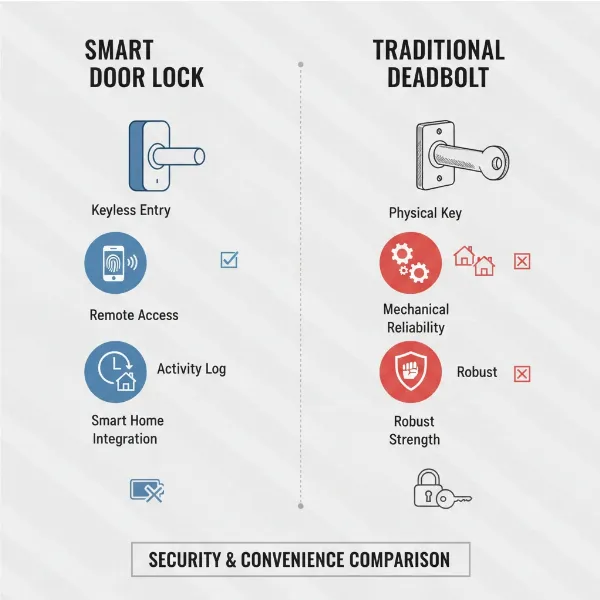 An illustrative graphic comparing smart door lock and traditional deadbolt features with distinct icons.
Installation and Maintenance: What to Expect
The installation and ongoing maintenance requirements differ significantly between smart door locks and traditional deadbolts. Understanding these aspects will help you anticipate the effort and resources needed for each option.
Smart Lock Installation
Many smart locks are designed to retrofit over an existing deadbolt, making them relatively straightforward for a DIY enthusiast to install. This often involves removing the old thumb turn and replacing it with the smart lock’s interior assembly, while the existing exterior key cylinder remains. However, for maximum security and seamless integration into a comprehensive smart home system, professional installation is often recommended. A professional ensures proper alignment of the bolt, optimal wireless connectivity, and correct configuration with other smart devices. Post-installation, the primary maintenance for smart locks involves managing battery life (typically 6-12 months depending on usage) and ensuring any associated apps or firmware are kept up-to-date for security and functionality.
Traditional Deadbolt Installation
Installing a traditional deadbolt is generally a simpler process, especially if you are replacing an existing lock. For new installations, it requires drilling precise holes in the door and door frame. Crucially, to maximize a traditional deadbolt’s security, proper installation is paramount. This includes using a reinforced strike plate with long screws that penetrate deep into the door frame’s studs, significantly increasing resistance against kick-ins. While many homeowners can perform a basic installation, a professional locksmith can ensure the lock is perfectly aligned and secured, optimizing its physical resistance. Minimal maintenance is typically required for traditional deadbolts, usually limited to occasional lubrication of the cylinder with a graphite-based lubricant to ensure smooth operation.
Addressing Common Concerns and Troubleshooting
Even with the best planning, issues can arise with any security system. Knowing how to address common concerns can save you time and stress.
Smart Lock Concerns
The most frequent concern with smart locks is battery failure. If your smart lock runs out of power, it typically has a physical key override, a port for a 9V battery jump-start, or a micro-USB input for temporary power. Regularly checking battery levels via the app and replacing them proactively is the best preventative measure. Connectivity issues can also occur if your Wi-Fi network goes down or if there’s interference. In such cases, local access methods like keypads or physical keys will still work. If you forget a PIN code or need to reset user access, most smart lock apps allow for easy management and reprogramming. Always ensure your smart lock’s firmware is updated to address potential bugs and enhance security.
Traditional Deadbolt Concerns
For traditional deadbolts, the primary concern is lost or stolen keys. If this happens, the security of your home is compromised, necessitating a rekeying of the lock or complete replacement. It’s always advisable to have a trusted, secure place for spare keys, avoiding common hiding spots. Another issue can be physical damage to the lock from attempted forced entry or general wear and tear, which may require repair or replacement of components to ensure continued security. Unlike smart locks, traditional deadbolts don’t typically encounter software issues or battery concerns, but their mechanical parts can wear over time.
Conclusion
Choosing between a smart door lock and a traditional deadbolt is a decision that balances modern convenience with fundamental security principles. Smart locks offer unparalleled flexibility, keyless access, remote control, and integration with your smart home, making daily life smoother and providing advanced monitoring capabilities. However, they introduce dependencies on power, connectivity, and software that require a degree of ongoing management. Traditional deadbolts, conversely, stand as robust guardians, offering unwavering physical security and mechanical reliability without the need for power or digital oversight, though they lack the smart features of their electronic counterparts.
Ultimately, the “better” choice depends on your individual needs, lifestyle, and comfort level with technology. Are you a tech-savvy homeowner seeking seamless integration and remote control, or do you prioritize bulletproof mechanical reliability above all else? Carefully consider your budget, your property’s specific security requirements, and how much convenience you truly desire. By weighing these factors, you can confidently select the door lock that provides the optimal blend of security and peace of mind for your home.
What security features are most important to you when securing your home’s entry points?
Câu Hỏi Thường Gặp
Are smart locks as secure as traditional deadbolts?
Yes, high-quality smart locks are generally considered as secure as traditional deadbolts, often adding layers of digital protection like encryption and remote monitoring. While traditional deadbolts excel in physical strength against brute force, smart locks offer security features like activity logs and tamper alerts.
What happens if a smart lock’s battery dies?
Most smart locks include a physical key override or an emergency power option (like a 9V battery jump-start) to ensure you can still gain entry even if the main batteries die. It’s recommended to monitor battery levels through the associated app and replace them proactively.
Can smart locks be hacked?
While any connected device carries a theoretical risk of hacking, reputable smart lock manufacturers employ advanced encryption and security protocols to minimize this risk. The likelihood of a successful hack is considered very low, often less common than traditional lock picking or forced entry.
Do I need Wi-Fi for a smart lock to work?
Not all smart locks require Wi-Fi. Some operate solely via Bluetooth or other protocols, allowing local control via a smartphone. However, Wi-Fi connectivity is usually necessary for remote access, notifications, and integration with broader smart home systems.
Are traditional deadbolts completely pick-proof?
No lock is entirely pick-proof, but high-security traditional deadbolts (ANSI Grade 1 or 2) are significantly more resistant to picking, bumping, and drilling than standard locks. Their complex internal mechanisms and robust construction deter most common picking methods.
Is it possible to combine both types of locks?
Yes, many homeowners choose to install both a smart lock and a traditional deadbolt on the same door. This “layered security” approach combines the physical resilience of a traditional deadbolt with the modern convenience and monitoring capabilities of a smart lock, offering comprehensive protection.
How much do smart locks typically cost compared to deadbolts?
Smart locks generally cost significantly more than traditional deadbolts, with prices typically ranging from $150 to $500 or more, depending on features and brand. Traditional deadbolts are usually much more affordable, often between $30 and $150 for quality models.